I’ve been around motorbike racing long enough to know that most fans have no idea how wild this sport’s origins really are.
You watch MotoGP or Supercross today and see million-dollar machines with electronics that would make NASA jealous. But you probably don’t know about the lunatics who started all this on modified bicycles with tiny engines strapped to the frame.
That’s the problem. We’ve lost the thread between then and now.
This article walks you through the complete story. From those first dust track races in the early 1900s to the digital precision of modern racing. I’m talking about the real history, not the sanitized version.
I’ve spent years digging through archives and talking to people who lived this sport. Racing isn’t just my job. It’s what I think about when I wake up and what keeps me up at night.
You’ll see exactly how motorbike racing started and how it evolved into what you watch today. The innovations that changed everything. The riders who risked it all. The moments that defined generations.
How motorbike racing started fmbmotoracing is part of a bigger story about human obsession with speed and competition.
No fluff here. Just the chronological story of how we got from there to here, and why it matters that you know it.
The Dawn of Two-Wheeled Speed: The First Daredevils (1890s-1930s)
Picture this: 1894. A guy straps a steam engine to a bicycle frame and calls it progress.
That’s how motorbike racing started fmbmotoracing.
Some historians say these early contraptions were just toys for rich guys with too much time. They argue that calling them “racing machines” is generous at best. The things barely worked, broke down constantly, and were about as reliable as a coin flip.
Fair point.
But here’s what they miss. Those unreliable machines sparked something that changed everything.
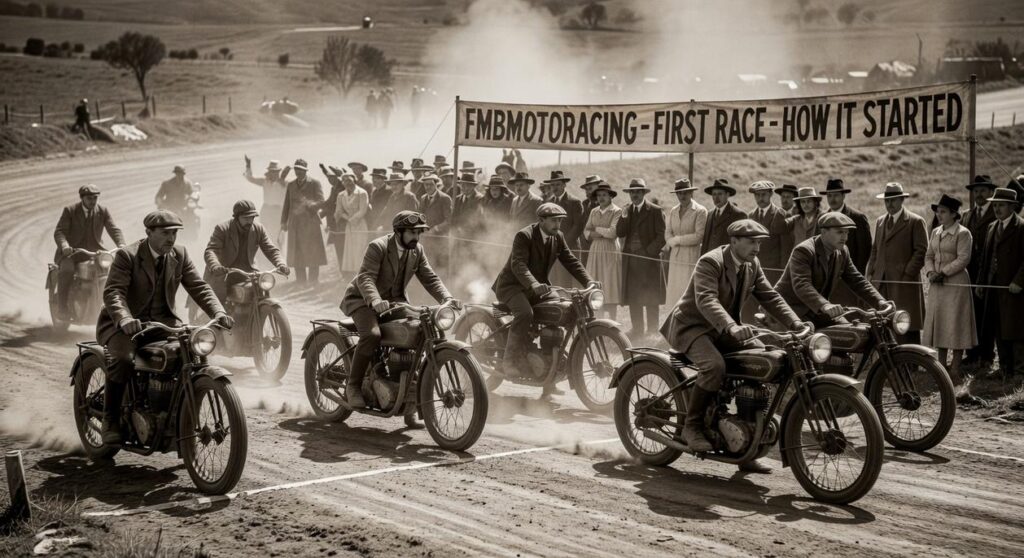
By 1897, riders were already lining up for city-to-city races across France. Paris to Nantes. Paris to Bordeaux. Hundreds of kilometers on dirt roads with machines that had maybe 2 horsepower if you were lucky.
The bikes weighed over 200 pounds. They had rigid frames that transferred every bump straight to your spine. Belt drives that snapped in the rain. Brakes that were more like suggestions than actual stopping mechanisms.
And the riders? They wore wool suits and leather caps.
In 1907, something bigger happened. The Isle of Man Tourist Trophy kicked off on a 15-mile mountain course. Sixty riders showed up for that first race. The course had over 200 corners, stone walls on both sides, and zero runoff areas.
You either made it or you didn’t.
Brooklands opened that same year in the UK. The world’s first purpose-built racing circuit. A concrete oval where riders could finally push their machines without dodging horse carts and pedestrians.
These weren’t just races. They were survival tests with a finish line.
The Post-War Boom and the Rise of Grand Prix Racing (1940s-1960s)
Here’s what most people get wrong about early Grand Prix racing.
They think it was some gentleman’s sport where wealthy Europeans casually raced on weekends. That the 1949 FIM Road Racing World Championship just appeared because someone thought it would be fun.
That’s not how motorbike racing started fmbmotoracing.
The truth? This was survival mode for manufacturers. After World War II, European factories needed to prove they could still build something worth buying. Racing became their proving ground.
Norton, Gilera, and MV Agusta didn’t race for trophies. They raced because winning on Sunday meant selling bikes on Monday. The motogp rivalries fmbmotoracing fans love today? They started here, born from real business stakes.
And the riders weren’t just athletes.
Geoff Duke and John Surtees were the first true professionals. They understood something that amateur racers didn’t: you could make a living doing this if you were good enough and willing to risk everything.
Duke especially changed the game. He showed up in leathers when everyone else wore cloth. People laughed until he started winning.
But here’s where it gets interesting.
The tech innovations from this era weren’t planned. Telescopic forks, multi-cylinder engines, those weird dustbin fairings that looked like someone bolted a trash can to the front (because aerodynamics were basically guesswork back then).
Most of these came from mechanics trying stuff in their garages. Not from engineering departments with million-dollar budgets.
That’s what made this period special. Raw experimentation without safety nets.
The Modern Era: Japanese Dominance and Global Superstars (1970s-2000s)
The Japanese changed everything.
I’m talking about the late 1960s and early 1970s. European manufacturers had ruled motorcycle racing since how motorbike racing started fmbmotoracing. Then Yamaha and Suzuki showed up with two-stroke engines that made the old four-strokes look like relics.
These weren’t just faster bikes. They were lighter. More responsive. And they screamed.
The two-stroke revolution caught everyone off guard. Italian and British factories scrambled to keep up, but the writing was on the wall.
Then came the Americans.
Kenny Roberts arrived in Europe in 1978 and people didn’t know what to make of him. He slid the rear tire through corners in a way European riders thought was reckless. “They told me I was crazy,” Roberts said in a 1979 interview. “But I won races, so they started copying me.”
He wasn’t wrong. Roberts won three consecutive 500cc world championships and changed how people thought about bike control.
But here’s what really changed the game.
Color television.
Barry Sheene understood this better than anyone. The British rider was fast, sure. But he also knew how to work a camera. “Racing is entertainment,” Sheene once said. “If people don’t watch, none of us have jobs.”
He was right. By the 1980s, races were broadcast across Europe and Asia. Riders became celebrities. Mick Doohan dominated the 1990s with five straight titles, and then Valentino Rossi showed up and took it to another level entirely.
But nothing lasts forever.
In 2002, the rulebook changed. The 500cc two-stroke era ended. Four-stroke 990cc machines took over, and just like that, a whole generation of racing history became the past.
Some riders adapted. Others didn’t. That’s racing.
A New Legacy Forged: The Origins of FMB Motoracing
Back in 2017, I saw something that didn’t sit right with me.
Grassroots riders had talent. Real talent. But they couldn’t break through because the established teams only looked at riders who already had money or connections.
Some people told me the system worked fine. They said if you’re good enough, someone will notice you. Just keep racing and wait your turn.
But that’s not how it actually played out.
I watched skilled riders give up because they couldn’t afford another season. Meanwhile, mediocre riders with deep pockets kept getting seats.
That’s how motorbike racing started fmbmotoracing. I decided to build something different.
The Core Mission
FMB wasn’t about chasing trophies right away (though we wanted those too). It was about creating a path for riders who had the skill but not the resources.
We focused on three things from day one:
- Technical training that actually prepared riders for professional competition
- Equipment development that maximized performance without requiring massive budgets
- A team culture where your lap times mattered more than your last name
After six months of testing our approach at local circuits, we knew we had something that worked.
Our first podium came in March 2018. Third place at a regional championship race. Not glamorous, but it proved the concept.
Within two years, other teams started adopting similar development programs. They saw that investing in raw talent could pay off if you gave riders the right support structure.
That shift? That’s what I’m most proud of.
A Rich History Still Being Written
You now have the full timeline in your hands.
From the first board-track racers to the specialized focus of modern teams like how motorbike racing started fmbmotoracing, you’ve seen how this sport evolved.
The history of motorbike racing is a relentless story of human and technical evolution. Every decade brought new machines and braver riders pushing the limits.
This heritage matters because it lives in every race you watch today. The technology on the track didn’t appear overnight. The spirit of those early riders still drives the champions you see now.
Here’s what I want you to do: The next time you watch a race, look for the echoes of this history. You’ll spot it in the technology, the tracks, and the way riders attack each corner.
The story isn’t finished. New chapters are being written every season.
 Grythara Cloud is the founder of FMB Motor Racing, a platform created for passionate auto and moto enthusiasts seeking informative coverage on racing culture, vehicle performance, and modern motorsport trends. With a deep appreciation for speed, engineering, and automotive innovation, Grythara built the platform to connect readers with practical insights and exciting developments from the racing world.